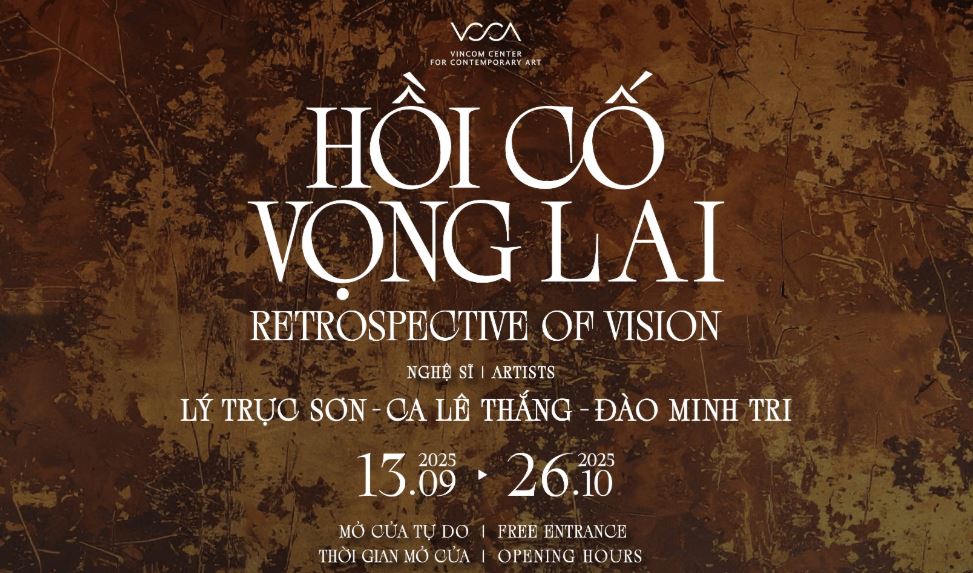
In September 2025, the exhibition Hồi Cố Vọng Lai | Retrospective of Vision opens, marking an important milestone in the history of Vietnamese art: the centennial of the Indochina College of Fine Arts (L’école des Beaux-Arts de l’Indochine) which trained and shaped generations of modern Vietnamese artists. The exhibition is not only an occasion to revisit nearly five decades of artistic practice by three artists born in 1949 - Lý Trực Sơn, Đào Minh Tri, and Ca Lê Thắng – but also a visual and theoretical experiment that questions Vietnamese artistic identity in dialogue with the global.
Hồi Cố Vọng Lai | Retrospective of Vision is not merely an assembly of works, but rather a “map of time” and “map of space” in contemporary Vietnamese art. It reveals how three artists, each from different regions, simultaneously absorbed external influences and drew on memory, materials, and local symbols. From Huế in the Central region, to Hà Nội in the North, and Bến Tre in the South, each regional experience has been received, reshaped, and transformed in artistic practice, producing creative trajectories that are distinct yet interconnected.
This historical and theoretical framework provides the foundation for understanding the three artists: Ca Lê Thắng with the river of the Mekong Delta; Đào Minh Tri with his fish motifs and North–South–Europe trajectory; and Lý Trực Sơn with earth and metaphysical abstraction. Each artist is emblematic of the intersections between locality, history, and globality, while reflecting the endeavor to construct an independent “Vietnamese artistic language” that is at once local and modern.
Born and raised in Bến Tre, Ca Lê Thắng takes the Mekong Delta as his creative source. The river, the flood season, and the alluvial landscape are not only subjects but living bodies, where art registers the relationship between humans, nature, and time. His Flood Season 2025 series extends two earlier cycles, expanding the space of memory and the present, simultaneously recording the rhythms of nature and evoking the poetics of the riverine world.
Born in Hà Nội, migrating to Sài Gòn in 1976, and studying at the École des Beaux-Arts in Paris in 1991, Đào Minh Tri is a quintessential figure of modern displacement, where artistic identity is continuously formed and reshaped through spatial-cultural movement (Bhabha, 1994). The fish motif lies at the heart of his work: lyrical, surreal, and reflective of human-nature-cosmos relations. Fish are not merely decorative or symbolic, but invoke biological and evolutionary logics, recalling Neil Shubin’s Your Inner Fish (2008), which regards the human body as the result of continuous evolution from fish to worms to bacteria. In Tri’s paintings, the fish symbol reflects history while opening a cosmology in which time and life are perceived as continuous, embodying the integration of folk symbolism into modern language without losing its local resonance.
In 2001, Tri developed a body of works exploring the complex relationship between humans and nature. Three works Human, Human-Fish, and Scream serve as key markers, each reflecting different shades of the fish-human motif. They demonstrate not only the artist’s creative direction in that year but also his evolving engagement with symbolism, materiality, and abstraction.
more in https://vccavietnam.com/en/exhibition-quotretrospective-of-visionquot-quothoi-co-vong-laiquot